
No city on earth packs so much Renaissance genius into so small a space. Florence is a walkable open-air museum where Brunelleschi's dome, Michelangelo's David, Botticelli's Venus and the goldsmiths' bridge of the Ponte Vecchio stand within minutes of one another. Here are the attractions worth building your trip around, with prices, opening hours and tips to skip the queues at the Uffizi, the Accademia and the dome climb.
 €30 combo
Duomo & Brunelleschi's Dome
Area
Centro Storico
Category
Cathedral
“The dome climb sells out days ahead — book a timed slot online, and go at opening to beat the heat on the 463 steps.”
 €25
€25Uffizi Gallery
Area
Centro Storico
Category
Art & Museums
“Reserve a timed ticket online and enter at opening or after 15:00 — the Botticelli rooms are calmest then.”
 €16
€16Galleria dell'Accademia (David)
Area
San Marco
Category
Art & Museums
“Book a timed slot online — David draws long queues. See him first, then the unfinished Slaves down the same hall.”
 Free
FreePonte Vecchio
Area
Centro Storico
Category
Landmark
“Cross it by day for the goldsmiths, then view it at sunset from Ponte Santa Trinita for the classic photograph.”
 €22
€22Palazzo Pitti & Boboli Gardens
Area
Oltrarno
Category
Palaces & Gardens
“The Palatine Gallery's Raphaels rival the Uffizi with a fraction of the crowds; save the Boboli terraces for late afternoon.”
 Free
FreePiazzale Michelangelo
Area
Oltrarno (hill)
Category
Piazzas & Views
“Walk up via the Rose Garden for the classic sunset panorama, then climb five more minutes to San Miniato for peace.”
 €12.50
Palazzo Vecchio
Area
Centro Storico
Category
Palaces & Gardens
“Climb the Arnolfo Tower for a Duomo-level view, and book the 'secret passages' tour for the hidden staircases.”
 Free
FreePiazza della Signoria & Loggia dei Lanzi
Area
Centro Storico
Category
Piazzas & Views
“The Loggia is a free open-air sculpture gallery — Cellini's Perseus and Giambologna's Rape of the Sabines stand under its arches.”
 €8
€8Basilica di Santa Croce
Area
Santa Croce
Category
Churches
“This is the burial place of Michelangelo, Galileo and Machiavelli — pick up the floor plan to find their tombs.”
 €30 combo
Baptistery & Gates of Paradise
Area
Centro Storico
Category
Churches
“The gilded doors facing the Duomo are copies — the restored originals are indoors at the Opera del Duomo museum.”
 €30 combo
Giotto's Campanile
Area
Centro Storico
Category
Piazzas & Views
“A less claustrophobic climb than the dome, and the reward is a photo of the dome itself — impossible from inside it.”
 €9
€9San Lorenzo & Medici Chapels
Area
San Lorenzo
Category
Churches
“The Medici Chapels and Michelangelo's New Sacristy have a separate entrance and ticket from the basilica — see both.”
 €10
€10Bargello Museum
Area
Centro Storico
Category
Art & Museums
“Florence's greatest sculpture museum and blissfully uncrowded — Donatello's bronze David is the highlight.”
 €7.50
€7.50Basilica di Santa Maria Novella
Area
Santa Maria Novella
Category
Churches
“Don't miss Masaccio's Trinity, the first great painting in true perspective — and the ancient perfumery nearby.”
 Free entry
Mercato Centrale
Area
San Lorenzo
Category
Market & Food
“Shop the ground-floor stalls in the morning, then eat upstairs in the buzzing food hall — try lampredotto if you're brave.”
 Free
FreeSan Miniato al Monte
Area
Oltrarno (hill)
Category
Churches
“Time a late-afternoon visit for the monks' Gregorian chant vespers, then catch sunset from the terrace outside.”
 €43
€43Vasari Corridor
Area
Centro Storico
Category
Art & Museums
“Newly reopened in 2024 after long restoration — access is by pre-booked ticket only, usually via the Uffizi.”
Florence attractions in detail
1.Duomo & Brunelleschi's Dome
The Cattedrale di Santa Maria del Fiore — everyone simply calls it the Duomo — is the beating heart of Florence and one of the defining achievements of the Renaissance. Its vast Gothic body, sheathed in pink, green and white marble, took nearly 150 years to build, but the real miracle is the dome that Filippo Brunelleschi raised over it between 1420 and 1436 without visible scaffolding, using a revolutionary double-shell of herringbone brickwork that remains the largest masonry dome in the world. Entry to the cathedral itself is free, though queues are long and the nave is surprisingly austere after the exuberant exterior; the treasures are elsewhere. The unmissable experience is the climb of 463 steps up between the dome's two shells to the lantern, passing within touching distance of Vasari's swirling Last Judgment fresco before emerging onto a walkway with the finest panorama in the city. The climb is by compulsory timed ticket, bundled into the Brunelleschi Pass along with the baptistery, Giotto's campanile, the crypt and the superb Opera del Duomo museum, where you can see Ghiberti's original Gates of Paradise and Michelangelo's Bandini Pietà up close. Book online well ahead, arrive early to avoid the midday heat inside the shell, and note the climb is steep, narrow and not for the claustrophobic. Allow a full half-day to do the whole cathedral complex justice.
Hours
Cathedral Mon–Sat ~10:15–16:45 (free); dome climb by timed ticket ~08:15–19:00
Price
Cathedral free; Brunelleschi Pass (dome + baptistery + campanile + museum + crypt) ~€30
Getting there
In the heart of the centro storico, a 10-minute walk from Santa Maria Novella station; no cars in the ZTL zone
Insider tip: The dome climb sells out days ahead — book a timed slot online, and go at opening to beat the heat on the 463 steps.
2.Uffizi Gallery
The Galleria degli Uffizi is the crown jewel of Florence's museums and one of the most important art collections on earth, housed in the grand U-shaped palace Giorgio Vasari built for Cosimo I de' Medici as the city's administrative offices — the 'uffizi' — in the 1560s. The Medici bequeathed their staggering hoard of paintings to the city on condition it never leave Florence, and the result is a chronological journey through the entire Renaissance along a top-floor corridor of light-filled rooms. The undisputed stars are Botticelli's Birth of Venus and Primavera, whose delicacy still stops crowds in their tracks, but the roll-call is relentless: Leonardo's Annunciation, Michelangelo's only surviving panel painting the Doni Tondo, Raphael, Titian's Venus of Urbino, Caravaggio's Medusa and Bacchus, and rooms of Giotto, Piero della Francesca and Filippo Lippi. The Vasari Corridor, the covered passage the Medici used to cross the river unseen, begins here. Because it is so popular, timed online tickets are essential and general queues can swallow hours; the earliest morning slot or the last couple of hours before closing give the calmest experience, and the collection is vast enough to reward a focused route rather than an exhausting march through every room. Allow at least three hours, wear comfortable shoes, and pause at the corridor windows for lovely views over the Arno and Ponte Vecchio.
Hours
Tue–Sun 08:15–18:30 (last entry 17:05; closed Mon)
Price
~€25 high season, ~€12 low season (+€4 booking); free first Sunday of the month
Getting there
On Piazzale degli Uffizi beside Piazza della Signoria; a 5-minute walk from the Duomo, no cars in the centre
Insider tip: Reserve a timed ticket online and enter at opening or after 15:00 — the Botticelli rooms are calmest then.
3.Galleria dell'Accademia (David)
The Galleria dell'Accademia exists, for most visitors, to house a single overwhelming object: Michelangelo's David, carved from a single flawed block of Carrara marble between 1501 and 1504 when the artist was in his mid-twenties, and moved here in 1873 to protect it from the elements after centuries outside the Palazzo Vecchio. Standing 5.17 metres tall at the end of a purpose-built tribune beneath a skylight, the figure of the young shepherd tensed in the moment before his battle with Goliath is more astonishing in person than any photograph suggests — the veined hands, the coiled contrapposto, the sheer scale and psychological charge. Leading up to him along the same hall are Michelangelo's four unfinished Prisoners or Slaves, figures that seem to struggle to free themselves from the raw stone, offering an extraordinary window into his belief that the sculpture already existed within the block and only needed releasing. Beyond the Michelangelos the museum holds a fine collection of Gothic and early-Renaissance panel paintings, a plaster-cast gallery and a museum of historical musical instruments from the Medici collection. It is a compact museum that can be seen in around ninety minutes, but David draws some of the longest queues in the city, so a timed online ticket is essential — turn up at opening, see David while the tribune is quiet, and combine the visit with the nearby San Marco monastery and Piazza San Marco.
Hours
Tue–Sun 08:15–18:50 (last entry 18:20; closed Mon)
Price
~€16 high season (+€4 booking); free first Sunday of the month
Getting there
On Via Ricasoli, a 10-minute walk north of the Duomo toward Piazza San Marco
Insider tip: Book a timed slot online — David draws long queues. See him first, then the unfinished Slaves down the same hall.
4.Ponte Vecchio
The Ponte Vecchio, the 'old bridge', is the enduring image of Florence — a stone arch bridge crossing the Arno at its narrowest point, its parapets crusted with tiny jewellers' and goldsmiths' shops that jut out over the water on wooden brackets. A crossing has stood here since Roman times; the present bridge dates from 1345, making it the oldest in the city and one of the few medieval bridges of its kind left in Europe. It has been lined with goldsmiths since 1593, when Grand Duke Ferdinando I evicted the butchers and tanners whose smells offended the nobles crossing above on the Vasari Corridor, the covered passage the Medici built along the top so they could move between the Palazzo Vecchio and Palazzo Pitti without mixing with the crowds. Famously, it was the only bridge in Florence the retreating German army did not blow up in 1944, reportedly on Hitler's personal order, though they destroyed the medieval streets at either end. Today the bridge is always thronged, and the little shops still sell gold and jewellery at prices to match the setting. It is free to cross and browse, but the most magical experience is to view it from a short distance — from the neighbouring Ponte Santa Trinita at sunset, when the low light turns the river gold and the bridge and its reflection glow — one of the great views in Italy and a photograph every visitor takes home.
Hours
Always open (shops ~10:00–19:00)
Price
Free to cross
Getting there
Spanning the Arno between the Uffizi and the Oltrarno; a 3-minute walk from Piazza della Signoria
Insider tip: Cross it by day for the goldsmiths, then view it at sunset from Ponte Santa Trinita for the classic photograph.
5.Palazzo Pitti & Boboli Gardens
Palazzo Pitti is the largest palace in Florence, a monumental block of rusticated stone begun in the 1450s for the banker Luca Pitti and later bought and hugely expanded by the Medici, who made it their principal residence and the seat of Tuscany's rulers for centuries. Today it holds a cluster of museums, but the standout is the Galleria Palatina, whose gilded state rooms are hung floor-to-ceiling in the old aristocratic manner with an astonishing collection assembled by the Medici and their successors — including eleven paintings by Raphael, among them the sublime Madonna della Seggiola and La Velata, along with Titians, Rubens, Caravaggio and Andrea del Sarto. Because it sits across the river and in the Uffizi's shadow, it draws far smaller crowds despite rivalling that gallery for quality. The palace also contains the Royal Apartments, a Gallery of Modern Art, a treasury and a costume museum. Behind and above the palace rise the Boboli Gardens, one of the earliest and most influential formal Italian gardens, laid out for the Medici in the sixteenth century as a green stage set of gravel avenues, clipped hedges, grottoes, fountains and antique and Renaissance statuary climbing the hillside, with terraces giving lovely views back over the city and the Duomo. It is a place to wander and breathe rather than tick off sights. Combine the Palatine Gallery with a late-afternoon stroll through the gardens and the neighbouring Bardini garden for one of the most rewarding, least hurried days in Florence.
Hours
Palace Tue–Sun 08:15–18:30 (closed Mon); Boboli Gardens daily ~08:15 until sunset
Price
Palatine Gallery ~€16; Boboli Gardens ~€10; combined passes available
Getting there
On Piazza de' Pitti in the Oltrarno, a 5-minute walk across Ponte Vecchio from the centre
Insider tip: The Palatine Gallery's Raphaels rival the Uffizi with a fraction of the crowds; save the Boboli terraces for late afternoon.
6.Piazzale Michelangelo
Piazzale Michelangelo is the great belvedere of Florence, a broad terraced square laid out in the 1860s on the hillside above the Oltrarno by the architect Giuseppe Poggi, and it delivers the single most famous view of the city. From its balustrade the whole of Renaissance Florence unfolds below in one sweep: the terracotta ocean of rooftops, Brunelleschi's dome and Giotto's campanile rising above them, the Palazzo Vecchio's tower, the bridges stitching across the green Arno, and the Tuscan hills fading into the distance behind. At the centre stands a bronze replica of Michelangelo's David, one of several copies of his works that give the square its name. It is deservedly popular and can be crowded, particularly at golden hour, when tour groups, couples, buskers and vendors gather to watch the sun set and light the city gold — arrive a little early to claim a spot on the wall. The walk up is part of the pleasure: from Ponte Vecchio you can climb through the terraced Giardino delle Rose (free, and a lovely spot in bloom) and the ramps Poggi designed, reaching the top in around twenty minutes, or take bus 12 or 13 if the heat or your legs argue against it. Crucially, do not stop at the piazzale: a five-minute climb further up brings you to the far quieter and more beautiful Romanesque church of San Miniato al Monte, with an even lovelier view and a fraction of the crowds. Come for sunset, bring a bottle of wine, and understand at a glance why Florence is called the cradle of the Renaissance.
Hours
Always open
Price
Free
Getting there
A 20-minute uphill walk from Ponte Vecchio via the Rose Garden, or bus 12/13 from the centre
Insider tip: Walk up via the Rose Garden for the classic sunset panorama, then climb five more minutes to San Miniato for peace.
7.Palazzo Vecchio
The Palazzo Vecchio has dominated Piazza della Signoria and the civic life of Florence for more than seven centuries. Built around 1300 as the seat of the republic's government, this crenellated fortress of rough stone topped by the slender 94-metre Arnolfo Tower became the Medici's ducal palace in the sixteenth century, when Cosimo I had Giorgio Vasari transform the interior into a dazzling showcase of grand-ducal power — and it remains the working town hall of Florence today. The high point inside is the enormous Salone dei Cinquecento, the Hall of the Five Hundred, its walls covered in Vasari's swirling battle frescoes and its ceiling a gilded coffered canopy, with Michelangelo's muscular Genius of Victory sculpture along one side; beneath the frescoes, some believe, may lie a lost Leonardo mural. Beyond it lie Cosimo's private apartments, the jewel-like Studiolo of Francesco I crammed with allegorical paintings, the Map Room and richly decorated chambers throughout. The palace is also wonderful for families: costumed guides run 'secret passages' tours through hidden staircases and the roof structure above the great hall, bringing the intrigue of the Medici court to life. For one of the best views in the city, climb the Arnolfo Tower — level with the top of the Duomo and far less crowded — for a panorama over the rooftops and the piazza below. Combine a visit with the free open-air sculpture of the square and the Loggia dei Lanzi just outside.
Hours
Fri–Wed 09:00–19:00, Thu 09:00–14:00 (seasonal)
Price
Museum ~€12.50; tower ~€12.50; combined ~€19.50
Getting there
On Piazza della Signoria, a 5-minute walk from the Duomo and beside the Uffizi
Insider tip: Climb the Arnolfo Tower for a Duomo-level view, and book the 'secret passages' tour for the hidden staircases.
8.Piazza della Signoria & Loggia dei Lanzi
Piazza della Signoria has been the political stage of Florence for seven hundred years, and it remains the grandest public space in the city — an L-shaped square dominated by the fortress bulk of the Palazzo Vecchio and functioning, remarkably, as a free open-air museum of world-class sculpture. Gathered here are a copy of Michelangelo's David marking the spot where the original stood for centuries, Bartolomeo Ammannati's huge Neptune Fountain with its sea gods, the mounted bronze of Cosimo I, and Baccio Bandinelli's Hercules and Cacus. The masterpieces continue under the graceful arches of the adjoining Loggia dei Lanzi, a fourteenth-century open gallery that shelters Benvenuto Cellini's electrifying bronze Perseus holding aloft the head of Medusa, Giambologna's spiralling marble Rape of the Sabine Women and a rank of antique Roman statues — all of it free to walk among at any hour. The square is soaked in history both glorious and grim: it was here, on this very pavement, that the fanatical friar Savonarola staged his Bonfire of the Vanities and, in 1498, was himself hanged and burned, an event marked by a small plaque near the fountain. Ringed by cafés (pricey for the setting), it is the natural crossroads of a visit to Florence, moments from the Uffizi and Palazzo Vecchio, and one of the few great Italian squares where you can stand among masterpieces without a ticket or a queue. Come by day to see the sculpture and by night when it is floodlit and quieter.
Hours
Always open
Price
Free
Getting there
In the centro storico beside the Uffizi, a 5-minute walk from the Duomo
Insider tip: The Loggia is a free open-air sculpture gallery — Cellini's Perseus and Giambologna's Rape of the Sabines stand under its arches.
9.Basilica di Santa Croce
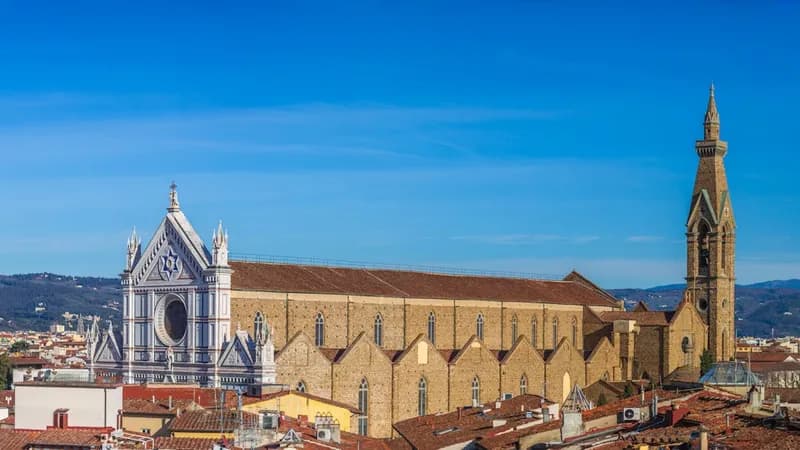
The Basilica di Santa Croce is the largest Franciscan church in the world and one of the most moving places in Florence, as much a national shrine as a house of worship. Behind its nineteenth-century marble façade lies a soaring Gothic interior begun in 1294 and, famously, the tombs and monuments of the greatest Italians — earning it the name the 'Temple of the Italian Glories'. Here lie Michelangelo, in a tomb designed by Vasari; Galileo, whose reburial in consecrated ground came long after the Church condemned him; the political thinker Niccolò Machiavelli; the composer Gioachino Rossini; and a cenotaph to Dante, who is actually buried in Ravenna, his city of exile. Beyond the illustrious dead, the church is a treasury of early-Renaissance art: chapels frescoed by Giotto and his followers with scenes from the lives of St Francis and the saints, a Crucifix by Donatello, and, off the tranquil cloister, Filippo Brunelleschi's exquisite Pazzi Chapel, a jewel of harmonious Renaissance geometry, and a museum housing Cimabue's great Crucifix, famously damaged in the catastrophic 1966 flood and painstakingly restored as a symbol of the city's recovery. The wide piazza in front, one of the largest in the city, has hosted festivals and the rough historic football game of calcio storico for centuries. Allow around an hour and a half, pick up the floor plan to locate the famous tombs, and let this be the place where the sheer weight of Florentine and Italian genius truly sinks in.
Hours
Mon–Sat 09:30–17:30, Sun 12:30–17:45 (last entry ~30 min before)
Price
~€8 (includes the museum and Pazzi Chapel)
Getting there
On Piazza Santa Croce, a 10-minute walk east of Piazza della Signoria
Insider tip: This is the burial place of Michelangelo, Galileo and Machiavelli — pick up the floor plan to find their tombs.
10.Baptistery & Gates of Paradise
The Battistero di San Giovanni is the oldest building in the heart of Florence, an octagonal Romanesque baptistery clad in white and green marble that stands directly in front of the Duomo and was long believed by Florentines to be an ancient Roman temple — so revered that Dante was baptised here, as were generations of the city's children. Its fame rests on two glories. Outside are the great bronze doors, above all the east set facing the cathedral, which Michelangelo is said to have called the 'Gates of Paradise': ten gilded panels of Old Testament scenes that Lorenzo Ghiberti laboured over for 27 years and which, with their mastery of perspective and depth, effectively announced the arrival of Renaissance sculpture; the panels on the building are faithful copies, the restored originals now safely displayed in the nearby Opera del Duomo museum. Inside, the ceiling erupts into one of the most breathtaking sights in the city — a vast thirteenth-century mosaic of over a million gold tesserae depicting the Last Judgment, ranks of angels and biblical scenes, dominated by a colossal figure of Christ, all glowing overhead like the inside of a jewel box. The baptistery is included in the combined Duomo tickets (the Brunelleschi, Giotto or Ghiberti passes), so it makes natural sense to visit it alongside the dome climb, the campanile and the museum. It is small and a visit takes only twenty minutes or so, but standing beneath that golden vault is one of the unforgettable moments of Florence.
Hours
Daily ~09:00–19:45 (seasonal; some restricted mornings)
Price
Covered by the ~€30 combined Duomo passes
Getting there
On Piazza San Giovanni directly in front of the Duomo, in the centro storico
Insider tip: The gilded doors facing the Duomo are copies — the restored originals are indoors at the Opera del Duomo museum.
11.Giotto's Campanile
Giotto's Campanile is the Duomo's elegant companion, an 85-metre free-standing bell tower rising beside the cathedral in the same harmonious skin of white, green and pink marble, and one of the most beautiful Gothic towers in Italy. It was begun in 1334 by the painter Giotto, then the most celebrated artist in Florence and appointed master of the cathedral works, though he died three years later having completed only the lower level; the tower was carried on by Andrea Pisano and finished by Francesco Talenti in 1359. Its lower storeys are decorated with a remarkable series of relief panels and statues — the originals now in the Opera del Duomo museum, with copies in place — depicting the story of humanity, the planets, the virtues, the sacraments and the liberal arts, a whole medieval encyclopaedia carved in stone. For visitors the great draw is the climb: 414 steps up a series of landings to a terrace at the top. Many find it a more rewarding ascent than the dome itself, partly because the staircase is less cramped and has viewing platforms to pause on along the way, and above all because from here you look straight across at Brunelleschi's dome in all its glory — the one great view of Florence that the dome climb, being inside it, cannot offer. It is included in the combined Duomo passes, so plan it alongside the baptistery and museum, and choose either the campanile or the dome for your climb if you cannot face both sets of steps in one day.
Hours
Daily ~08:15–19:00 (last entry ~40 min before)
Price
Covered by the ~€30 combined Duomo passes
Getting there
Beside the Duomo on Piazza del Duomo, in the centro storico
Insider tip: A less claustrophobic climb than the dome, and the reward is a photo of the dome itself — impossible from inside it.
12.San Lorenzo & Medici Chapels
San Lorenzo was the parish church of the Medici, and the complex around it charts the family's rise from merchants to grand dukes and their unrivalled patronage of the Renaissance. The basilica itself, rebuilt from 1419 by Filippo Brunelleschi, is a masterpiece of early-Renaissance restraint — cool grey pietra serena columns and arches laid out with mathematical harmony against plain white walls — though its façade was left as bare brown stone, a design by Michelangelo that was never executed. Inside are Donatello's dramatic bronze pulpits, his last works, and the Old Sacristy, another Brunelleschi jewel decorated by Donatello. Adjoining the church is the Laurentian Library, whose extraordinary vestibule and cascading stone staircase Michelangelo designed in a restless, almost proto-Baroque style that broke every classical rule. But the unmissable element, reached by a separate entrance and ticket at the back, is the Cappelle Medicee, the Medici Chapels: the opulent, dome-topped Chapel of the Princes lined in dark inlaid marble and semi-precious stone, and beyond it Michelangelo's New Sacristy, where he sculpted the brooding allegorical figures of Dawn, Dusk, Day and Night reclining on the tombs of two Medici dukes — among the most powerful funerary sculptures ever made. Around the church sprawls the leather-and-souvenir stalls of the San Lorenzo market and the food halls of the Mercato Centrale, so a visit combines art, history and lunch. Buy the chapels ticket separately, and do not leave without seeing Michelangelo's tombs.
Hours
Basilica Mon–Sat ~10:00–17:30; Medici Chapels Tue–Sun ~08:15–18:50 (check closures)
Price
Basilica ~€9; Medici Chapels ~€9 (separate ticket)
Getting there
On Piazza San Lorenzo beside the Mercato Centrale, a 5-minute walk from the Duomo
Insider tip: The Medici Chapels and Michelangelo's New Sacristy have a separate entrance and ticket from the basilica — see both.
13.Bargello Museum
The Museo Nazionale del Bargello is Florence's finest sculpture collection and, because it is overshadowed by the David-focused Accademia and the painting-heavy Uffizi, one of its most rewarding and least crowded museums. It occupies a forbidding medieval palace begun in 1255, the oldest public building in the city, which served over the centuries as the seat of the chief magistrate, the police headquarters (the 'bargello') and a prison with a grim history of executions, its severe courtyard now hung with the carved coats of arms of former magistrates. Inside, the collection is a roll-call of Renaissance sculpture. The star is Donatello's bronze David of the 1440s, the first free-standing nude cast since antiquity and a work of startling, ambiguous sensuality that helped define the era; his earlier marble David and the swaggering St George stand nearby. Around them are early works by Michelangelo, including his Bacchus and a tondo of the Madonna; Giambologna's famous winged Mercury poised on a breath of air; and the two competing trial panels for the Baptistery doors by Ghiberti and Brunelleschi, displayed side by side so you can judge the contest that launched the Renaissance. Further rooms hold Della Robbia glazed terracottas, medieval ivories, arms and armour and decorative arts. It is a manageable, uncrowded museum that rewards a couple of hours, and for anyone who wants to understand Florentine sculpture beyond the one giant marble in the Accademia, it is essential — check the sometimes-restricted opening hours before you go.
Hours
Wed–Mon ~08:15–13:50 (hours vary; some afternoon openings; check ahead)
Price
~€10 (higher with exhibitions)
Getting there
On Via del Proconsolo between the Duomo and Santa Croce, a 5-minute walk from Piazza della Signoria
Insider tip: Florence's greatest sculpture museum and blissfully uncrowded — Donatello's bronze David is the highlight.
14.Basilica di Santa Maria Novella
Santa Maria Novella is the principal Dominican church of Florence and the first great basilica most visitors pass, since it stands right beside the main railway station that shares its name. Its façade is one of the landmarks of Renaissance architecture: the lower Gothic section of green and white marble was topped in the 1460s by Leon Battista Alberti with a serenely classical upper storey and the elegant scrolled volumes that reconciled the two, a design of mathematical harmony that influenced church fronts for centuries. The vast, austere Gothic interior is a gallery of masterpieces. Its greatest treasure is Masaccio's fresco of the Holy Trinity, painted around 1427 and generally regarded as the first painting to deploy true, mathematically constructed linear perspective, opening an illusionistic chapel into the wall so convincingly that contemporaries were astonished. Beyond it are Domenico Ghirlandaio's radiant fresco cycle in the choir chapel (in which a young Michelangelo may have trained), Filippino Lippi's frescoes, Giotto's Crucifix hanging in the nave, and Brunelleschi's wooden Crucifix in a side chapel. The tranquil green cloisters alongside, frescoed by Paolo Uccello, and a small museum complete the visit. A short walk away is the Officina Profumo-Farmaceutica di Santa Maria Novella, an ancient monastic pharmacy and perfumery founded by the friars in 1221 and still selling soaps, scents and elixirs in frescoed rooms — a fragrant, atmospheric stop worth combining with the church. Allow around an hour for the basilica and cloisters.
Hours
Mon–Thu ~09:30–17:30, Fri 11:00–17:30, weekends ~09:00–18:30 (seasonal)
Price
~€7.50 (includes cloisters and museum)
Getting there
On Piazza Santa Maria Novella beside the main train station of the same name
Insider tip: Don't miss Masaccio's Trinity, the first great painting in true perspective — and the ancient perfumery nearby.
15.Mercato Centrale
The Mercato Centrale is the belly of Florence, a magnificent nineteenth-century market hall of cast iron and glass built in 1874, and it offers one of the best and most affordable food experiences in the city across two very different floors. The ground floor is the traditional produce market, a bustling, aromatic labyrinth of stalls where Florentines and chefs still shop for the raw materials of Tuscan cooking: butchers with hanging bistecca and trays of tripe, cheesemongers stacked with pecorino, delis heaped with prosciutto, salami and fresh pasta, fishmongers, greengrocers piled with seasonal vegetables, porcini and truffles, and bakers and wine sellers. It is a wonderful place to browse, photograph, taste and pick up picnic supplies or edible souvenirs. Upstairs, a soaring space was transformed in 2014 into a modern gourmet food hall, open late into the evening, where a ring of specialist counters cook everything to order — fresh pasta, pizza from a wood oven, steak, fried seafood, cured meats, gelato, craft beer and Tuscan wine — which you carry to communal tables in the buzzy central seating area. It is casual, lively and reasonably priced, a great option for a flexible lunch or dinner where everyone in a group can eat what they fancy. Don't miss the chance to try Florentine street-food classics like a lampredotto or bollito panino from a traditional stall. Surrounded by the leather and souvenir stalls of the San Lorenzo market, it combines easily with the basilica and Medici Chapels next door.
Hours
Ground floor Mon–Sat ~07:00–15:00; first-floor food hall daily ~09:00–24:00
Price
Free to enter; stalls and meals vary
Getting there
On Piazza del Mercato Centrale in San Lorenzo, a 5-minute walk from the Duomo and station
Insider tip: Shop the ground-floor stalls in the morning, then eat upstairs in the buzzing food hall — try lampredotto if you're brave.
16.San Miniato al Monte
San Miniato al Monte is the loveliest church in Florence and, for many visitors, the most memorable single place in the city — a perfect Romanesque basilica crowning the highest point on the south bank, a short climb above the crowds of Piazzale Michelangelo yet blessedly peaceful. Begun in 1013 on the spot where, legend holds, the beheaded early-Christian martyr St Minias carried his own severed head, it presents one of the most beautiful façades in Tuscany: a geometric composition of green Prato and white Carrara marble, crowned by a glittering thirteenth-century mosaic of Christ between the Virgin and St Minias and topped by a gilded eagle, the emblem of the wool guild that funded it. The interior is equally rare and atmospheric, little changed in a thousand years: a raised choir above an ancient crypt, an intricate inlaid marble pavement patterned with zodiac signs and animals, more golden apse mosaics, a free-standing Renaissance chapel by Michelozzo and a sacristy frescoed with the life of St Benedict by Spinello Aretino. A community of Benedictine (Olivetan) monks still lives here, and if you time your visit for late afternoon you can hear them sing Gregorian chant at vespers in the candlelit crypt — an unforgettable experience. Outside, the terrace and the monumental cemetery beside the church offer a view over Florence that rivals or beats the famous one just below, and with far fewer people. Combine it with sunset at the piazzale, but save your real time for the church at the top — it is free, and it is the soul of the city.
Hours
Daily ~09:30–13:00 & 15:00–19:00 (seasonal; monks' chant at afternoon vespers)
Price
Free
Getting there
A 5-minute climb above Piazzale Michelangelo; walk up from Ponte Vecchio (~30 min) or bus 12/13
Insider tip: Time a late-afternoon visit for the monks' Gregorian chant vespers, then catch sunset from the terrace outside.
17.Vasari Corridor
The Corridoio Vasariano is one of the most extraordinary and romantic structures in Florence — a kilometre-long covered passageway that Giorgio Vasari built in just five months in 1565 on the orders of Cosimo I de' Medici, so that the ruling family could walk in privacy and safety between their offices at the Palazzo Vecchio and Uffizi and their new residence across the river at the Palazzo Pitti, without ever setting foot among the citizens below. Threading through buildings, along the top of the Ponte Vecchio — which is why the bridge's malodorous butchers were replaced with goldsmiths — and skirting a church, the corridor is a physical expression of Medici power and paranoia, and it later housed the gallery's celebrated collection of artists' self-portraits. After being closed to the public for decades, and shut entirely following a 1993 Mafia bombing nearby, the corridor underwent a major restoration and reopened in 2024, giving visitors the rare chance to retrace the grand-ducal route and enjoy its unique views out over the Arno and the bridge through its windows. Access is strictly by pre-booked, timed ticket, generally combined with entry to the Uffizi, and numbers are limited, so it must be reserved well in advance. It is a specialist experience rather than a first-timer's essential — the newly reopened corridor is now presented more as an architectural and historical walkway than the dense picture gallery it once was — but for repeat visitors, Medici obsessives and anyone fascinated by the secret machinery of Renaissance power, walking Vasari's hidden passage is a genuine thrill.
Hours
Tue–Sun by timed booking (as part of the Uffizi complex; closed Mon)
Price
~€43 combined Uffizi + corridor ticket
Getting there
Entered from within the Uffizi Gallery on Piazzale degli Uffizi
Insider tip: Newly reopened in 2024 after long restoration — access is by pre-booked ticket only, usually via the Uffizi.